Adaptive vs. Transformative Learning
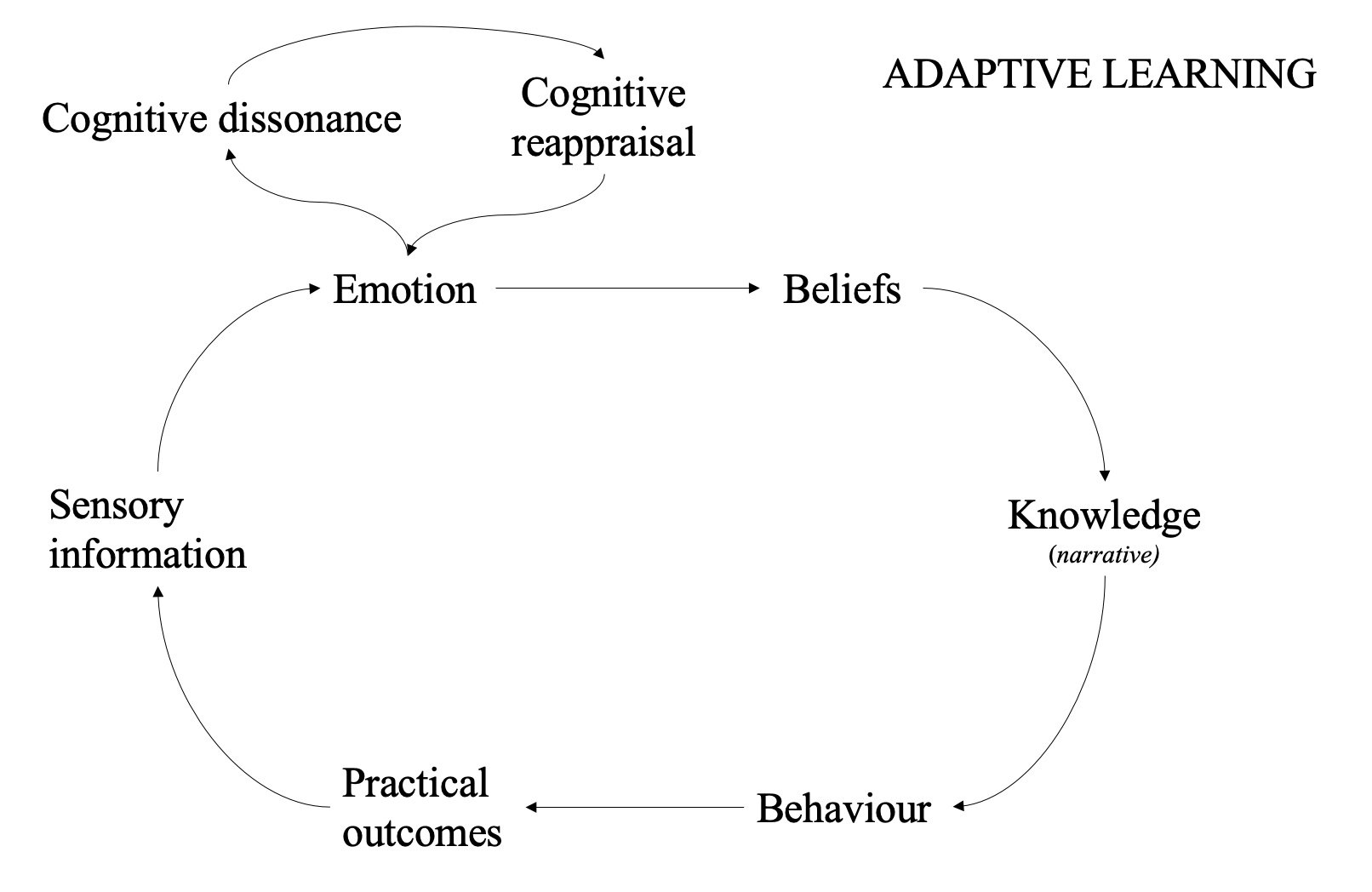
Adaptive learning within capacity.
When cognitive dissonance can be integrated through reappraisal, emotional signals inform belief updating without overwhelming the system. Beliefs consolidate into coherent narrative knowledge, guiding behaviour and producing practical outcomes that feed back as usable sensory information. Change occurs through small, embodied, iterative adjustments that preserve system coherence over time.
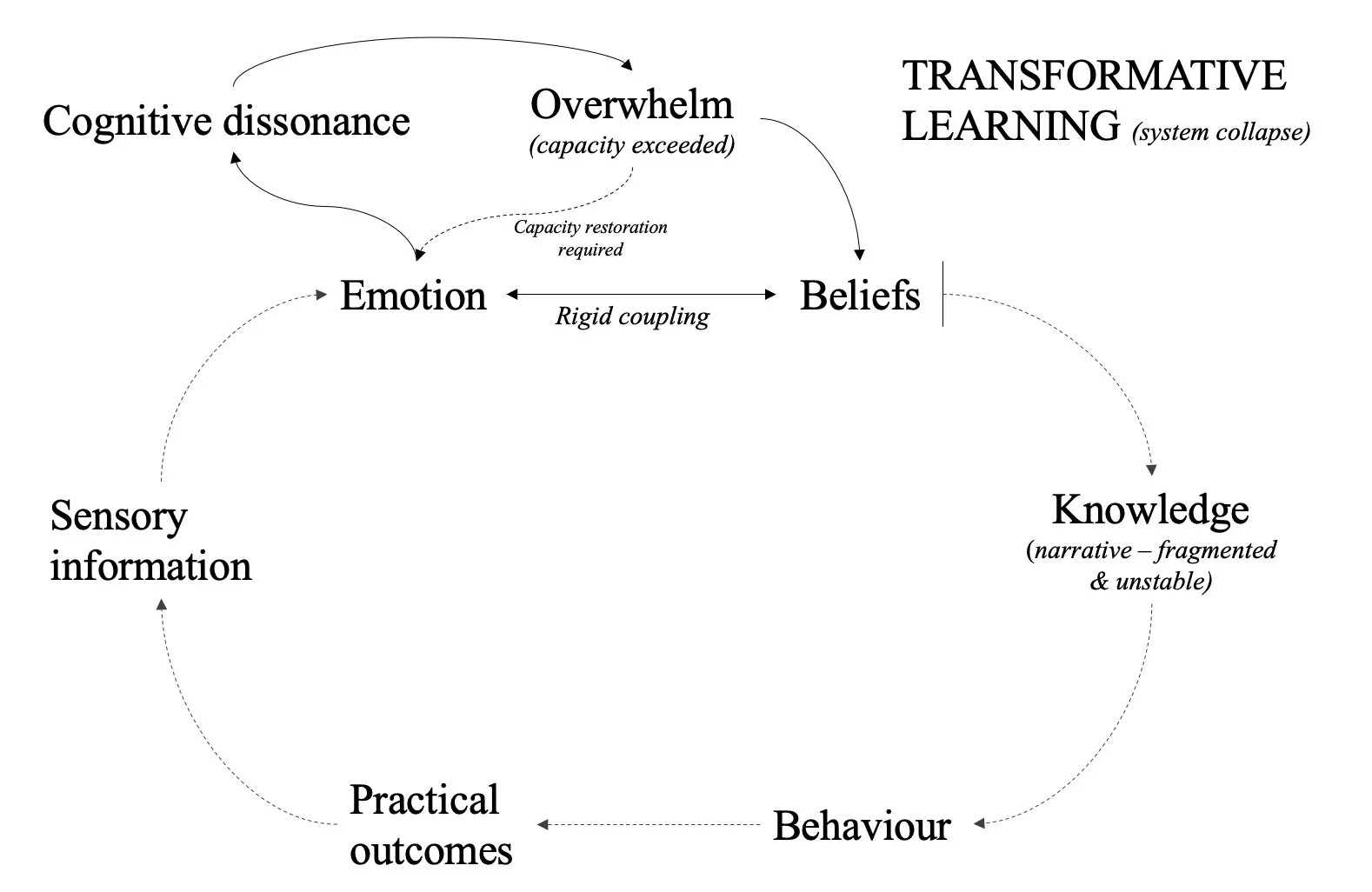
Transformative learning following system collapse.
When repeated cognitive dissonance exceeds adaptive capacity, overwhelm interrupts belief updating and narrative integration. Emotion becomes rigidly coupled to beliefs, narrative knowledge fragments, and behaviour continues without producing adaptive feedback. Learning cannot resume through iteration alone; restoration of capacity is required before coherence and adaptive learning can re-emerge.
This model draws on work from complex systems theory, learning theory, affective neuroscience, and embodied cognition. The full reference list can be found below.
Adaptive capacity, resilience, and complex systems
Moore, M.-L., Olsson, P., Nilsson, W., Rose, L., & Westley, F. (2014). Navigating emergence and system reflexivity as key transformative capacities. Ecology and Society, 19(2), 20. https://doi.org/10.5751/ES-06315-190220
Jeppesen, J. K., & Eriksson, K. (2019). Adaptive capacity in complex systems: A resilience perspective. Systems Research and Behavioral Science, 36(5), 605–618. https://doi.org/10.1002/sres.2604
Holling, C. S. (2001). Understanding the complexity of economic, ecological, and social systems. Ecosystems, 4(5), 390–405. https://doi.org/10.1007/s10021-001-0101-5
Walker, B., Holling, C. S., Carpenter, S. R., & Kinzig, A. (2004). Resilience, adaptability and transformability in social–ecological systems. Ecology and Society, 9(2), 5.
Transformative learning and collapse
Mezirow, J. (1997). Transformative learning: Theory to practice. New Directions for Adult and Continuing Education, 1997(74), 5–12. https://doi.org/10.1002/ace.7401
Carter, S., & Nicolaides, A. (2023). Transformative learning: An emotional (r)evolution. Journal of Transformative Education, 21(2), 89–108. https://doi.org/10.1177/15413446221136157
Taylor, E. W. (2007). An update of transformative learning theory: A critical review of the empirical research (1999–2005). International Journal of Lifelong Education, 26(2), 173–191. https://doi.org/10.1080/02601370701219475
Narrative, meaning-making, and belief formation
Bruner, J. (2004). Life as narrative. Social Research, 71(3), 691–710.
Meretoja, H. (2014). The narrative turn in fiction and theory: The crisis and return of storytelling. Palgrave Macmillan.
Bruner, J. (1991). The narrative construction of reality. Critical Inquiry, 18(1), 1–21. https://doi.org/10.1086/448619
Embodied cognition, emotion, and consciousness
Thompson, E. (2007). Mind in life: Biology, phenomenology, and the sciences of mind. Harvard University Press.
Thompson, E. (2010). Embodied cognition. In L. Shapiro (Ed.), The Cambridge handbook of embodied cognition (pp. 38–55). Cambridge University Press.
Damasio, A. (1999). The feeling of what happens: Body and emotion in the making of consciousness. Harcourt Brace.
Damasio, A. (2018). The strange order of things: Life, feeling, and the making of cultures. Pantheon Books.
Panksepp, J. (1998). Affective neuroscience: The foundations of human and animal emotions. Oxford University Press.
Solms, M. (2021). The hidden spring: A journey to the source of consciousness. Profile Books.
Solms, M. (2019). The hard problem of consciousness and the free energy principle. Frontiers in Psychology, 10, 2714.
Cognition–emotion integration
Jasanoff, A. (2018). The biological mind: How brain, body, and environment collaborate to make us who we are. Basic Books.
Pessoa, L. (2008). On the relationship between emotion and cognition. Nature Reviews Neuroscience, 9(2), 148–158. https://doi.org/10.1038/nrn2317
Pessoa, L. (2009). Cognition and emotion. Scholarpedia. http://www.scholarpedia.org/article/Cognition_and_emotion