15 Biomarkers Every Person With Hypothyroidism Needs to Check

There’s more to thyroid testing than just TSH.
When I got a diagnosis of hypothyroidism and Hashimoto’s, I was a bit lost initially. Six years ago, there was far less information available on the internet about thyroid disease, and I had yet to switch from my career in wine and environmental science to integrative medicine. It took me years to fully understand the thyroid, the series of chemical reactions involved in thyroid function, and what could get in the way of them.
And yet, despite the plethora of content centred on thyroid health, I’ve yet to see a comprehensive guide to the lab work you should get done to see what’s driving your hypothyroidism biochemically. That’s exactly what this article is all about.
The ranges I cite below are my own clinical working ranges rather than diagnostic reference intervals. They reflect the ranges I use when looking for patterns across multiple biomarkers, symptoms and clinical history; an isolated result outside one of these ranges does not necessarily indicate a problem, but it can point towards a pattern worth investigating.
But First, A Little Background Information
Before we dig into biomarkers, ranges, and testing, I want to make sure that you fully grasp what your thyroid does. Because I still see a lot of people with hypothyroidism who don’t fully understand why they feel so terrible when their thyroid is struggling.
Your thyroid is a small, butterfly-shaped organ in your neck that plays a major role in energy production for your entire body. But it doesn’t operate on its own. It’s the endpoint of a feedback loop called the hypothalamic-pituitary-thyroid (HPT) axis: your hypothalamus releases thyrotropin-releasing hormone (TRH), which tells your pituitary to release thyroid-stimulating hormone (TSH), which tells your thyroid to produce hormone. When thyroid hormone rises, the hypothalamus and pituitary sense it and ease off. When it falls, they push harder. TSH is a signal from the top of this loop, not a direct readout of what your cells are receiving, which is part of why a single TSH result rarely tells the full story.
Most of what the thyroid releases is thyroxine (T4), an inactive storage form. The active form your cells use, triiodothyronine (T3), comes mainly from converting T4 in tissues throughout the body, via enzymes called deiodinases. Type 1 deiodinase does this in the liver and kidneys; type 2 handles it locally in tissues like the brain. So thyroid function depends not just on how much hormone the gland makes, but on how well your body converts it into a usable form, tissue by tissue, based on local demand.
Once T3 is where it’s needed, it acts inside the cell nucleus, switching genes on and off that govern metabolic rate, heart and nervous system function, gut motility, and more. A major target is your mitochondria: thyroid hormone is one of the master regulators of mitochondrial function, shaping how many mitochondria your cells build and how efficiently they generate adenosine triphosphate (ATP). That’s a large part of why low thyroid function so often feels like fatigue, brain fog, and a body running on low power.
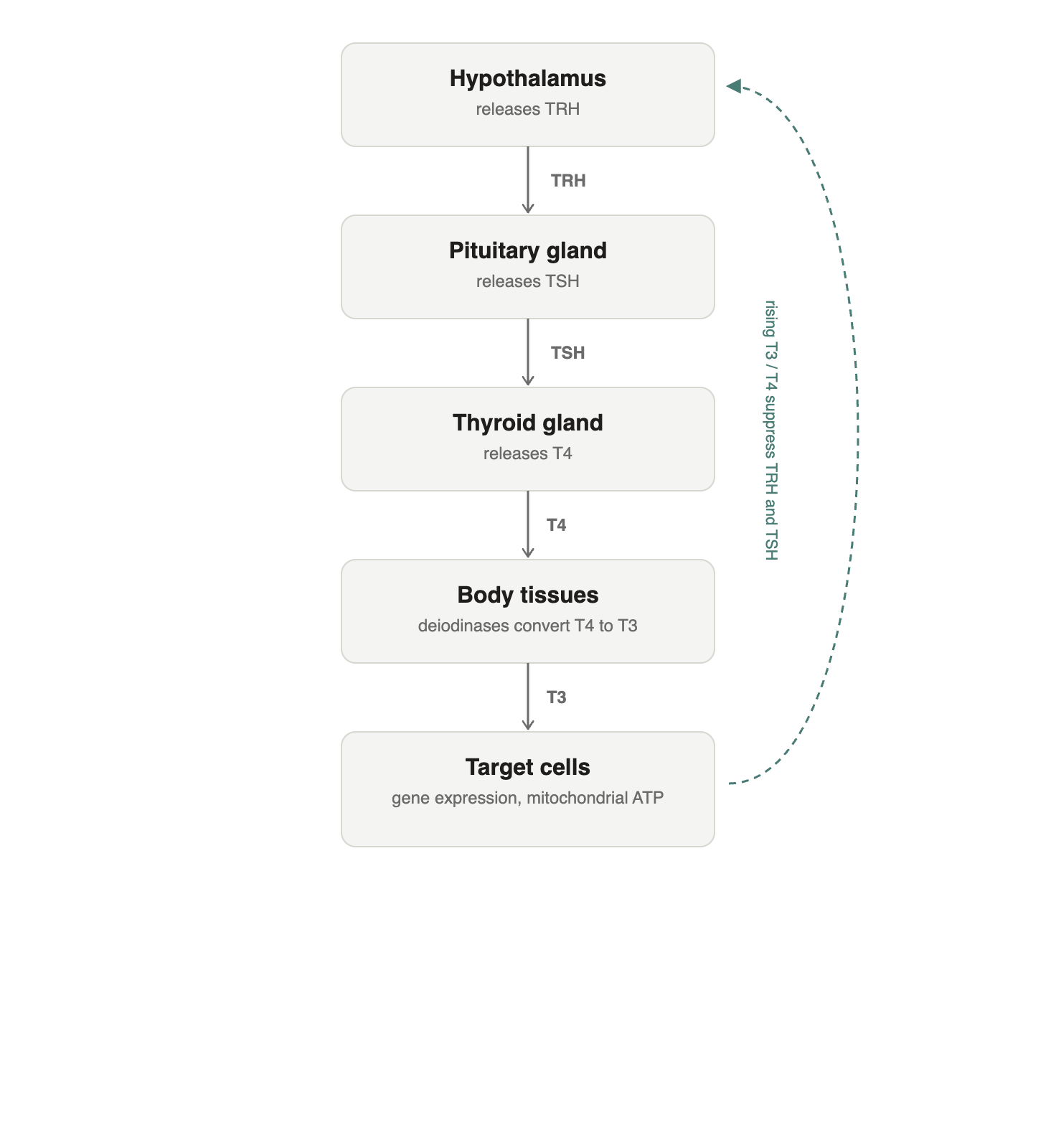
The signalling cascade between your cells, thyroid, pituitary, and hypothalamus.
So “my thyroid is struggling” can mean trouble at any point in this chain: the signalling loop, the conversion step, or the cellular energy system downstream, which is exactly why the one number most healthcare providers check is rarely enough.
The Thyroid Markers You Actually Need to Check
Most healthcare providers check TSH and stop there before telling you your thyroid is “fine” or that there’s an issue. I experienced this recently when my TSH had risen in early pregnancy to 5.6, far from the optimal range. I was assigned to an endocrinologist at my local hospital after the obstetrician found out that I had a history of Hashimoto’s and hypothyroidism. Without asking me what my T4 and T3 results were, he began talking about thyroid medication. Luckily, I had ordered a full thyroid panel myself two weeks after I got my initial result, and it showed that not only was my TSH back within normal range, but my thyroid hormones and antibodies were all optimal. My body had likely been adjusting to increased energy demands in early pregnancy, normalising once calibrated.
That gap between what happened in my body and what the endocrinologist assumed from a single number is common, and it isn’t just an individual oversight. Many clinical guidelines actually recommend starting with TSH alone and only adding further tests if that one result falls outside range. But TSH is a signal from the top of a feedback loop, not a direct measurement of what’s happening in your tissues. If you have Hashimoto’s, a family history of thyroid disease, or symptoms that don’t match your labs, that single data point rarely tells you enough, as I found out myself.
Here’s the panel I recommend running together, not one at a time. The optimal ranges below are tighter than standard lab reference ranges, which are built to catch disease, not to map function.
TSH. Optimal: 0.5–2 mIU/L. Standard lab range runs closer to 0.4–4.0 mIU/L, so you can be “in range” and still functioning well below optimal. Pregnancy shifts this again, with a lower upper limit in the first trimester, which is why my own result of 5.6 got flagged.
Free T4. Optimal: 14–16 pmol/L (1.1–1.2 ng/dL). This is the storage hormone your thyroid actually produces. When FT4 is adequate but FT3 is relatively low, impaired conversion or adaptive downregulation are worth investigation.
Free T3. Optimal: 3.2–4.4 pg/mL (4.9–6.8 pmol/L). This is the active hormone your cells use. Low T3 despite normal T4 can reflect impaired conversion, which may occur under physiological stress, illness, inflammation or inadequate nutrient availability.
Thyroid peroxidase antibodies (TPOAb). Optimal: <35 IU/mL, ideally as close to zero as possible. The most sensitive marker for autoimmune thyroid activity, and it can be elevated years before TSH ever moves.
Thyroglobulin antibodies (TgAb). Optimal: <20 IU/mL, ideally as close to zero as possible. Worth checking alongside TPOAb, since a small number of people are positive for one and not the other.
Reverse T3 (rT3). Optimal: <15 ng/dL. This inactive form rises under stress, illness, or under-fuelling. It’s an adaptive signal, not a fault, and shouldn’t be pushed against with high-dose thyroid hormone.
Together, these six markers show how much hormone your thyroid is producing, how much your body is converting into usable form, whether autoimmunity is driving the picture, and where your system might be rerouting hormone under load.
But Wait, There’s More
Looking at the markers outlined above is going to tell you what is happening. The next part of this puzzle is why.
Most people get told by the practitioner that hypothyroidism is genetic or “we just don’t know”. That’s technically true, and also incomplete. Genetics can load the gun, but whether hypothyroidism actually fires often comes down to whether the raw materials for making and converting thyroid hormone are available in the first place.
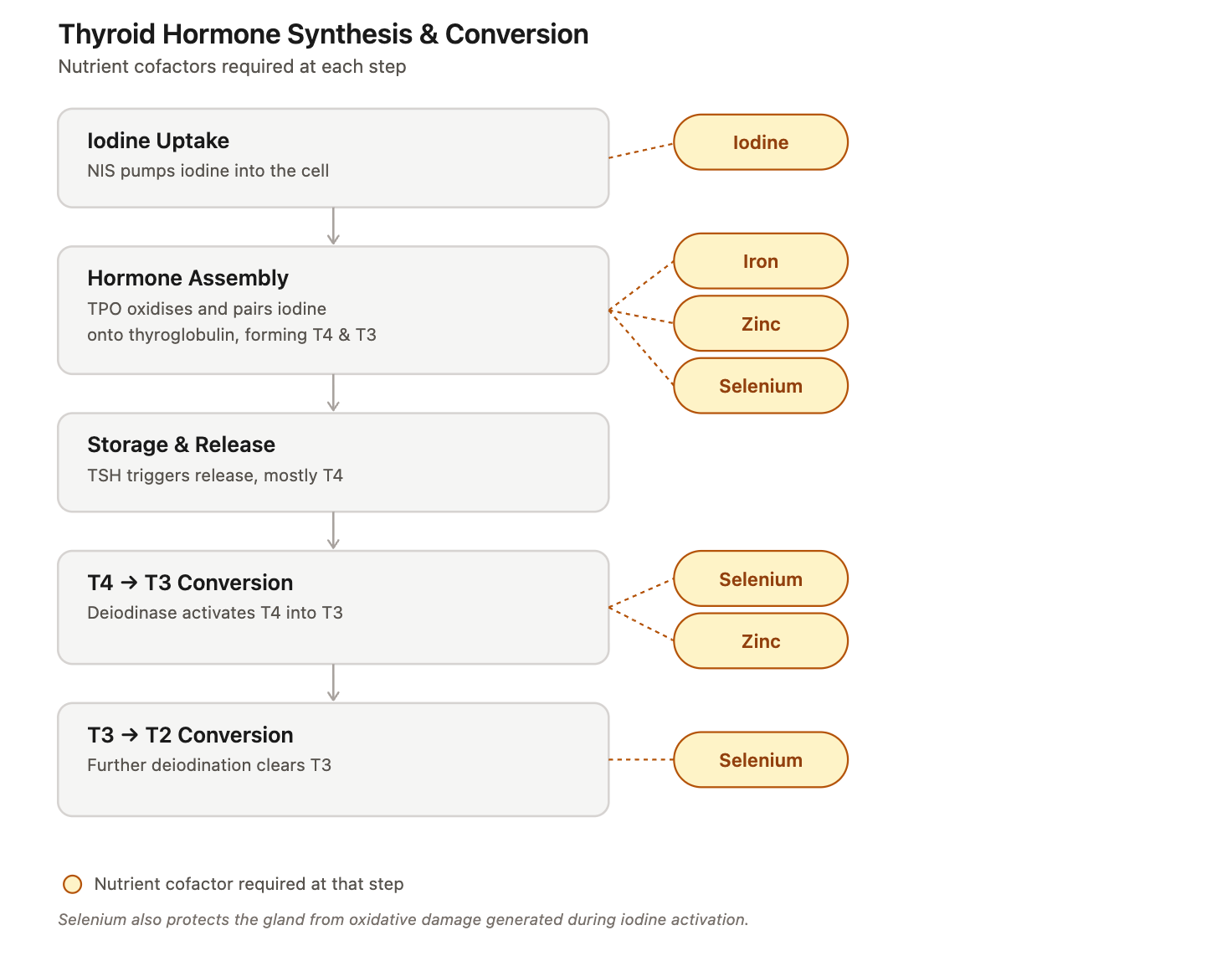
The chain reaction of biochemical events that leads to the active forms of thyroid hormone, T3 and T2, being produced.
Every step in the synthesis pathway above needs a specificnutrient to run. When one of them is short, the system doesn’t break; it adapts, and that adaptation can look a lot like genetic inevitability. Here are the primary markers worth checking.
Iodine. Optimal: serum 40–92 µg/L, or a spot urinary iodine of 150–250 µg/L (a more practical test that reflects recent intake). Iodine is the literal building block of thyroid hormone. Too little and there’s nothing to make T4 from; too much can trigger or worsen autoimmune thyroid disease in susceptible people, so more is not automatically better.
Selenium. Optimal: 100–130 µg/L (1.27–1.65 µmol/L). Selenium does double duty: it’s required by the deiodinase enzymes that convert T4 into T3 and T3 into T2, and it protects the thyroid gland from the oxidative byproducts generated while iodine is being activated. Low selenium is one of the more overlooked reasons someone can have adequate T4 and still feel hypothyroid.
Iron. Optimal: ferritin 100–300 ng/mL, transferrin saturation 20–45%. Iron is a cofactor for thyroid peroxidase, the enzyme that assembles the hormone. In clinic, I generally see people do best once ferritin is comfortably replete, rather than simply inside the laboratory reference interval.
Zinc. Optimal: 14–18 µmol/L. Zinc supports both the enzymes involved in hormone synthesis and the receptors that let T3 act once it reaches a cell, so a deficiency can blunt the signal even when the hormone itself is present.
Copper is worth a brief mention too. It isn’t a direct cofactor in thyroid hormone production, but it’s needed to make ceruloplasmin, the protein that mobilises iron for use elsewhere in the body, including at the thyroid. If iron markers are low and not responding to supplementation, copper status and a zinc-to-copper ratio (optimal 0.7–1.0) are worth a look before assuming the problem is intake alone.
One in Three of My Clients Are Missing This Nutrient
Riboflavin isn’t a nutrient most people think to ask about, and it wasn’t one I thought much about early in my own career either. But by my own rough estimate, about a third of the people I work with are short on it. Some have thyroid symptoms, while others have symptoms completely unrelated. It’s suggested to me that riboflavin deficiency is far more widespread, and far less appreciated, than it gets credit for, and that it impacts people in a range of different ways.
Part of the reason it flies under the radar is mechanical. Thyroid peroxidase, the enzyme that actually assembles T4, doesn’t work alone. To run its reaction, it needs a steady supply of hydrogen peroxide, essentially fuel for the process. That hydrogen peroxide is made by two enzymes called DUOX1 and DUOX2, sitting right alongside thyroid peroxidase in the thyroid gland. DUOX1 and DUOX2 can’t do their job without FAD, the active form of vitamin B2, which acts as a kind of relay, passing electrons along so the reaction can happen. No FAD, no hydrogen peroxide. No hydrogen peroxide, no fuel for thyroid peroxidase, no matter how much iodine, iron, or selenium you have on board.
What makes this worth knowing is that the relationship runs in both directions. Thyroid hormone is also needed to convert riboflavin into its active FAD form in the first place. So a riboflavin shortfall can slow hormone production, and the resulting drop in thyroid hormone can then slow the body’s ability to activate the riboflavin it does have. It’s a loop that can reinforce itself once it starts, and neither side needs to be severe for that to happen.
Riboflavin is also awkward to test directly. The most accurate functional test is hard to access through most labs. In practice, it’s often picked up indirectly, since riboflavin is required by one of the enzymes that recycles homocysteine. If homocysteine sits above optimal while other B vitamins involved in methylation three look fine, riboflavin is worth considering:
Holotranscobalamin. Optimal: >100 pmol/L.
Folate. Optimal: 20–40 nmol/L.
Vitamin B6 (P5P). Optimal: 30–80 nmol/L.
Homocysteine. Optimal: 5–7.5 µmol/L.
An organic acids test can also flag it, since glutaric acid and ethylmalonic acid tend to rise when riboflavin-dependent enzymes are running short.
Two more nutrients play a smaller supporting role here. Niacin (vitamin B3) feeds into the same reaction as an electron source, and DUOX1 and DUOX2 also depend on calcium to switch on. Neither is something you’d typically test or supplement for on the strength of thyroid symptoms alone, but it’s worth knowing the full cast of characters.
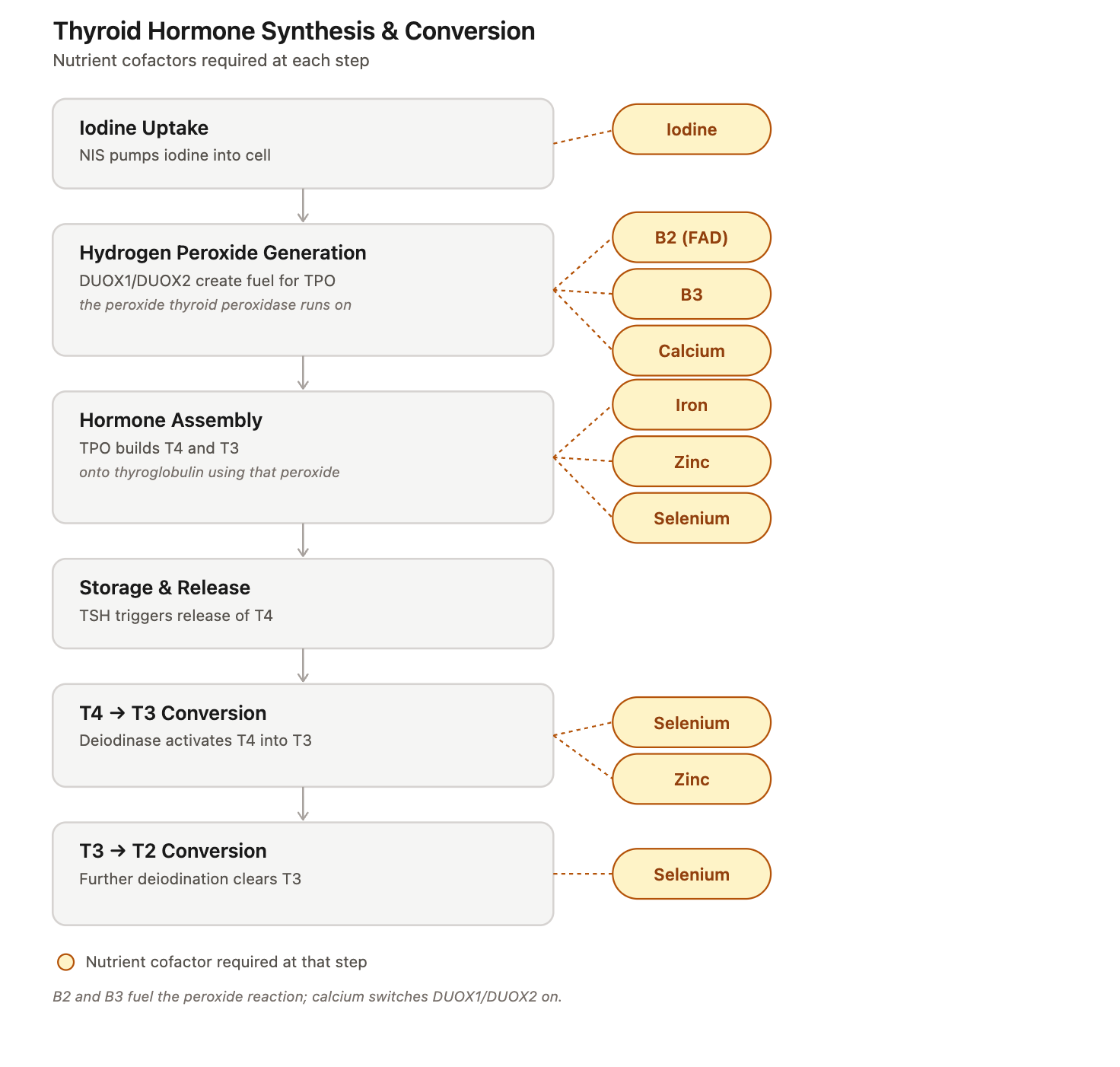
A more complete picture of the nutrients your thyroid needs.
Bring This to Your Next Appointment
None of this is the easiest thing to bring to a standard doctor's appointment. A GP working from a template will usually run TSH alone, and if you ask for a full panel with antibodies, reverse T3, ferritin, and riboflavin-adjacent markers, don't be surprised by some pushback or a polite version of "that's not necessary." That's not a reflection of your judgment. It's mostly a reflection of how public health systems are built: efficient triage for common patterns, not exploration of your specific one.
That's worth naming, because it changes what "worth bringing" actually means here. This isn't about collecting more numbers for their own sake. Every marker in this article maps to a specific point in a chain of biochemical events: whether your thyroid can make enough hormone, whether your body can convert it into a form your cells can use, whether autoimmunity is contributing to the picture, and whether the raw materials, iodine, iron, zinc, selenium, riboflavin, are actually present to run the machinery. A single TSH result can't distinguish between any of those possibilities. This panel can.
Here's the full list in one place:
TSH
Free T4
Free T3
Thyroid peroxidase antibodies (TPOAb)
Thyroglobulin antibodies (TgAb)
Reverse T3
Ferritin and transferrin saturation
Zinc
Selenium
Iodine (serum or urinary)
Copper (worth checking if iron isn't responding to supplementation)
Calcium
Holotranscobalamin, folate, B6, and homocysteine (to screen indirectly for riboflavin status)
Niacin (B3), if accessible, though standard serum testing for this one is limited and it's more often assessed indirectly through the same organic acids panel that flags riboflavin
Not every practitioner will run all of these, and not every lab offers them through the public system. Some will need to be requested privately, or interpreted by someone trained to read a functional pattern rather than tick boxes against a standard reference range. That's a genuine access issue, not a personal failing, and it's worth naming rather than glossing over.
What this list gives you, even before a single result comes back, is a different question to ask. Not "is something wrong with me," but "what is my body being asked to do, and does it currently have what it needs to do that." That's a more useful question, and usually a more answerable one.
If this resonated, and you'd like support making sense of your own results or building a plan around them, I offer both a free orientation call and first appointments. You can book either via the link below.